AI and the Future of Work
-
Episode Number : 411
Jeremy Burton, GM of Observability at Snowflake, explains why the data layer was never a commodity: it’s the whole game. He shares how an AI agent facing 10 sources of truth can deliver the wrong answer with total confidence, and why evals are becoming essential to running an LLM.
Show moreShow lessJeremy Burton is the General Manager for Observability Business Unit at Snowflake following the acquisition of Observe, the developer-centric observability platform where he served as CEO. A veteran enterprise technology executive with a thirty-year career spanning Silicon Valley, Jeremy previously served as Executive Vice President of Marketing and Corporate Development at Dell, President of Products at EMC, and CEO of Serena Software, with earlier leadership roles at Symantec, Veritas, and Oracle. He has served on Snowflake’s board of directors since 2015 and sits on the McLaren Racing Advisory Board.
In this episode, Jeremy draws on watching customers go from collecting a petabyte of data in a decade to generating one every two days to make the case that without a real data foundation, enterprises will either get the wrong answer from their AI, or burn a fortune getting to the right one.
In this conversation, we discuss:
- Why pointing AI agents at hundreds of terabytes of telemetry burns tokens fast, and what Jeremy says has to change first.
- How an AI agent facing 10 sources of truth can deliver the wrong answer with total confidence.
- Why Jeremy calls the LLM “a new animal in the zoo,” and what that means for anyone trying to monitor AI agents.
- How AI agents are starting to build the knowledge graphs that once took human implementation teams to create.
- Why evals are becoming essential to running an LLM, and what a single model release can do to existing applications.
- What Jeremy would tell his younger self stepping off the plane to meet Mark Benioff, and the career superpower he undervalued.
Explore the conversation:00:00 Intro and AI Fun Fact: Pope Leo XIV’s Encyclical and Anthropic’s Vatican Address
04:08 Introducing Jeremy Burton, GM for Observability at Snowflake and Former CEO of Observe
07:09 The Observe Origin: Pitching Observability as a Unified Data Problem Natively on Snowflake
10:20 Observability as a Data Problem: Metrics, Logs and Traces
13:39 Snowflake Culture and Leadership Eras
16:58 Joining Snowflake: Running Observe After the Acquisition
18:57 Data Foundation vs. Frontier Models: Balancing CPU and GPU Burn with Context
22:23 Snowflake’s AI Strategy: Data Foundation and Sources of Truth
28:11 Non-Human AI Telemetry: Using Knowledge Graphs to Structure Machine Data
32:31 Probabilistic AI and LLM Observability: Why Evals and Harnesses Are Essential
36:14 Future of Work: The “LLM as Modern-Day Tractor” and Software Engineering Practices
41:18 Career Superpowers: The Value of Networks and Relationships in Silicon Valley
43:06 Closing: Where to Connect with Jeremy Burton and Explore Snowflake ObservabilityResources:
- Subscribe to the AI & The Future of Work Newsletter
- Connect with Jeremy Burton on LinkedIn
- AI fun fact article
- On How Ashu Garg, General Partner at Foundation Capital, finds and invests in the future of AI
- Other episodes mentioned on the show: Automate the Work, Amplify the Humanity, with Snowflake’s CPO Arnnon Geshuri
–
Learn how Box connects secure enterprise content with AI to power smarter workflows. Visit box.com/ai to learn more.
-
Episode Number : 410
Johanna “JJ” Jackman, Chief People Officer at Freshworks, explains why responsible AI isn’t slow, it’s bold with human judgment. She shares how HR acts as Customer Zero and why executives must share responsibility with employees for continuous AI fluency.
Show moreShow lessJohanna “JJ” Jackman is the Chief People Officer at Freshworks, the global cloud-based customer service and IT service management platform serving over 75,000 corporate clients worldwide. With an international career across six countries, JJ began her professional journey in the Australian mining industry before transitioning into high-growth technology.
Prior to joining Freshworks in 2023, she served as Chief People Officer at Airtable, Chief Human Resources Officer at Pure Storage, and Vice President of HR at LinkedIn during its formative scaling era, and currently sits on the Board of Directors at Grafana Labs.
In this episode, JJ sits down with Dan to discuss why modern employee experience requires transitioning from traditional organizational charts to workflow-centric platforms, how HR functions as Customer Zero to eliminate operational friction across enterprise IT and HR services, why executive leaders must share responsibility with employees for continuous AI fluency, and how the convergence of human judgment with digital teammates is redefining workforce planning and career mobility.
In this conversation, we discuss:
- Why evaluating enterprise software transformation requires abandoning rigid organizational charts in favor of end-to-end, workflow-centric employee experiences.
- How serving as “Customer Zero” allows internal people teams to co-design IT and HR service platforms that eliminate administrative friction for global workforces.
- What the creation of dedicated AI enablement roles reveals about shifting corporate strategy from traditional headcount planning to dynamic capability modeling.
- Why fostering organizational resilience requires a mutual commitment between employers and workers to maintain continuous AI fluency and career relevance.
- How enterprise leaders can establish transparent guardrails to ensure autonomous algorithms inform decision-making without supplanting human judgment.
- What a data-driven, structured job search framework teaches early-career professionals about asserting personal agency in an algorithmically filtered hiring market.
Explore The Conversation
00:00 Intro and listener mailbag: Allison in Trenton on special episode 21 and WEF global job trends
02:35 Introducing Johanna “JJ” Jackman, Chief People Officer at Freshworks
04:09 From mining underground to tech executive: Formative lessons in human-centric leadership
06:22 The Freshworks culture trifecta: Manager support, peer collaboration, and goal clarity
08:47 From org charts to workflows: Framing “People Platform as a Service” with IT leadership
12:08 HR as customer zero: Streamlining Lives HR and eliminating friction across the employee journey
15:32 Rewriting the employment contract: Executive role-modeling and shared AI fluency
21:45 Capacity over headcount: “AI in Motion” days and hiring an AI enablement leader
29:48 Responsible AI in HR: Safeguarding human judgment in promotion and performance decisions
33:34 Empowering early-career professionals: Agency, unlearning, and Josh’s mathematical job hunt
41:52 The 2031 vision: Digital employee IDs, merging CPO-CIO roles, and remote leadership
45:01 Closing: Where to connect with Johanna “JJ” Jackman and explore FreshworksResources:
- Subscribe to the AI & The Future of Work Newsletter
- Connect with Johanna “JJ” Jackman on LinkedIn
- Other episodes and research mentioned on the show:
–
See why Freshworks was named a Leader in the 2026 Gartner® Magic Quadrant™ for ITSM. Learn more → freshworks.com/dant
-
Episode Number : 409
Ryan Gavin, CMO of Slack, explains why single-player AI tools fail to deliver enterprise productivity gains. He makes the case that dropping agents into an organization without a multiplayer strategy doesn’t just fail, it actively backfires.
Show moreShow lessRyan Gavin is Chief Marketing Officer at Slack, the global collaboration platform used by more than 200,000 organizations across 150 countries. Since joining Slack, Ryan has helped drive a 250% increase in revenue while championing the launch of Slack’s AI-first capabilities and agentic integrations.
A seasoned technology executive, Ryan previously served as Chief Growth Officer at Convoy and held senior leadership roles at Amazon Web Services and Microsoft, where he managed multi-billion-dollar business units.
In this episode, Ryan draws on watching hundreds of enterprise AI rollouts up close to make the case that dropping agents into an organization without a strategy doesn’t just fail to help, it actively backfires.
In this conversation, we discuss:
- Why single-player AI tools fail to deliver enterprise productivity gains, and how deploying autonomous agents into collaborative, multiplayer environments unlocks hidden software value.
- How a conversational interface connects unstructured team dialogue with structured CRM data, allowing employees to query enterprise systems without opening underlying software tabs.
- What the concept of “headless software” reveals about democratizing access to sales and operational insights across non-technical departments.
- Why transparent, step-by-step reasoning and strict permission inheritance are essential for building trust when introducing AI tools into enterprise workflows.
- How leading organizations elevate Slack from a conventional IT collaboration expense into a core strategic driver for company-wide AI adoption.
- What executive advice for emerging professionals highlights the enduring value of curiosity, creativity, and adaptability in a rapidly changing job market.
Explore the conversation
00:00 Show Intro, a Team Human Success Story, and Meet Ryan Gavin
03:44 Ryan Gavin’s Path to Becoming CMO of Slack
04:57 Slack’s New Job in the Age of AI Agents
07:53 Designing SlackBot to Strengthen Human Collaboration
12:31 Headless Salesforce and Slack as the New Front Door
16:50 Slack as 2% of Your AI Budget and the Problem With ‘Work About Work’
21:37 Trust, Transparency, and the AI Black Box in SlackBot
25:28 From Slash Commands to Every Employee as a Builder
31:40 Winning Share of Wallet in a Zero-Sum AI Budget
35:54 Advice for Workers Who Feel Left Behind by AI
39:35 Where to Find Ryan Gavin and Slack
Resources
- Subscribe to the AI & The Future of Work Newsletter
- Connect with Ryan on LinkedIn
- Other episodes mentioned on the show:
- On How Silvio Savarese, EVP and Chief Scientist at Salesforce, navigated the real challenges of taking AI from the ivory tower to corporate labs (Episode 297)
- On How Kai Nunez, Vice President of Research & Insights at Salesforce, shares the secret to making tech teams own responsibility for AI ethics (Season 2, Episode 47)
–
See why Freshworks was named a Leader in the 2026 Gartner® Magic Quadrant™ for ITSM. Learn more → freshworks.com/dant
-

Episode Number : SE 31
Kartik Sakthivel, CIO of John Hancock, explains how a 164-year-old insurer decides which AI gets fast tracked and which gets slowed down. Recorded live at Ai4 2026, he shares the one question he asks every time the business brings him an AI idea.
Show moreShow lessKartik Sakthivel is the Chief Information Officer at John Hancock, the life insurer that turned 164 years old in April 2026 and is part of Manulife. Before joining, he spent eight and a half years at LIMRA and LOMA, the oldest and largest trade association in financial services, which gave him a view across carriers few technology leaders ever get.
Recorded live from the floor of Ai4 2026, this lightning round explores what it takes to bring AI into a company founded during the Civil War, and why he tells his teams that what they build today becomes the legacy for the next 164 years.
Kartik and host Dan Turchin dig into why he believes every technology leader should think of themselves as a business leader first, how a regulated industry decides what to fast track and what to slow down, and what he says to people who are watching a machine learn to do the thing that made them valuable.
What You’ll Learn
- Why uptime and mean time to repair are table stakes for a modern technology organization, and what Kartik measures instead
- How a highly regulated business draws the line between internal AI that gets fast tracked and anything customer facing that does not
- Why there are more AI pilots in insurance than planes at a major airport at peak hour, and how to find use cases that are neither too small to matter nor too large to finish
- The question he asks every time the business brings him an AI idea, and why the answer is sometimes something far simpler
- What he tells colleagues watching automation absorb part of their role, and where the time that comes back should be reinvested
🎙️ Part of our Ai4 2026 compilation series.
Listen to the full compilation here: https://www.buzzsprout.com/520474/episodes/19816277
Resources
-
Episode Number : 408
Cesar Carvalho, CEO of Wellhub, explains why employee wellness and business performance are not opposing forces. He shares why AI should fund reskilling instead of justifying layoffs, and how Wellhub’s AI coach scales personalized care to millions.
Show moreShow lessCesar Carvalho is the co-founder and CEO of Wellhub, the corporate well-being platform connecting millions of employees to top-tier fitness, mindfulness, therapy, nutrition, and sleep partners across 18 countries.
Since founding the company as Gympass in 2012, Cesar has raised nearly $900 million in venture funding, reached a $2.4 billion valuation, and grown Wellhub to serve over 50,000 corporate clients worldwide.
In this episode, Cesar sits down with Dan to discuss why treating employee wellness and business performance as opposing forces is a false dichotomy. Tune in to hear his perspective on why AI should be leveraged to fund employee reskilling rather than justify job cuts, how Wellhub’s AI wellness coach scales hyper-personalized care to millions of subscribers, why less than 10% of global healthcare spending goes toward prevention, and how pivoting during the 2020 pandemic transformed a near-death crisis into a multi-product wellness ecosystem.
In this conversation, we discuss:
- Why framing corporate wellness as an adversary to business performance is a false dichotomy, and how employee health directly drives bottom-line execution.
- How granting employees 30 minutes of paid work time daily to experiment with AI tools fosters a culture of innovation and continuous reskilling.
- What the structural imbalance between preventive “well care” and reactive “sick care” reveals about the urgent need to redesign enterprise benefits.
- How an AI-powered wellness coach expands personalized fitness and mindfulness guidance from hundreds of thousands to millions of corporate subscribers.
- Why strict data minimization policies and phased beta testing provide a trusted framework for deploying AI in sensitive health environments.
- What pivoting a global business model during the 2020 pandemic teaches founders about mission alignment, resilience, and turning near-death moments into catalysts for growth.
Explore the conversation:
00:00 Show Intro and Newsletter Shoutouts
02:07 AI Fun Fact: Chatbots and Mental Health Risks
04:01 Introducing Cesar Carvalho, CEO of Wellhub
05:03 From Harvard Dropout to Corporate Wellness: The Founding of Gympass
06:56 The “Team Human” Ethos: Making Well-Being Ubiquitous at Scale
09:14 Performance vs. Health: Why Employee Well-Being Directly Drives Execution
12:37 Calling Out AI Layoffs: Are Employees Expendable?
14:12 Reskilling Over Layoffs: Why Wellhub Invests in Existing Talent
16:34 Personalization at Scale: Expanding the AI Wellness Coach Across Millions
20:19 Responsible AI at Wellhub: Data Minimization and Governance Standards
22:36 Sick Care vs. Well Care: Quantifying a 20-35% Drop in Healthcare Costs
26:36 Eliminating Friction: Redesigning Employee Benefits Outside Open Enrollment
32:02 Human-First Design and Why AI Will Disrupt Legacy Companies
33:23 The Pandemic Pivot: Turning a Near-Death Event into Wellhub’s Evolution
37:27 Advice to His Younger Self and the Best Time to Start a Company
39:45 Closing Thoughts and Sign-Off
Resources:
- Subscribe to the AI & The Future of Work Newsletter
Connect with Cesar on LinkedIn - AI Fun Fact
- On how one good decision made Thomas Otter (venture capitalist at Acadian Ventures) an accidental HR tech pioneer
–
See why Freshworks was named a Leader in the 2026 Gartner® Magic Quadrant™ for ITSM. Learn more → freshworks.com/dant
-
Episode Number : SE 30
Todd Barr, CEO of Axonis, explains why you do not need to centralize your data to start doing AI. Recorded live at Ai4 2026, he shares what an auditable decision actually records and why decisions themselves are about to become a category of data.
Show moreShow lessTodd Barr is the CEO of Axonis and has spent his career in high growth software infrastructure, living through the shift from Unix to Linux, the rise of DevOps, and the blockchain era before landing in AI. Axonis was built by technical founders with 25 years each in large scale infrastructure across government, defense and intelligence, where sharing the underlying data was never an option.
Recorded live from the floor of Ai4 2026, this lightning round explores why you do not have to centralize your data to start doing AI, and what it takes to make a decision you can defend later.
Todd and host Dan Turchin dig into what an auditable decision actually records, how governance can live at the data node instead of the application layer, the distance between collecting sensor data and acting on it, and why Todd believes decisions themselves are about to become a category of data.
What You’ll Learn
- Why centralizing your data is not a prerequisite for AI, and how a federated architecture holds up when nodes go offline and come back
- What an auditable decision captures: the data used, the model and its version, the reasoning, and the person who attested to it
- How attribute based access control decides what each operator or agent is allowed to see, enforced at the data itself
- The sensor to decision gap, and how a flood management team went from raw readings they could not interpret to acting on them in real time
- Why collecting data and acting on it are two different problems, and what opens up once that distance closes
- What becomes possible once decisions are stored as data, from the cost of each decision to who in the organization decides better
🎙️ Part of our Ai4 2026 compilation series. Listen to the full compilation here: https://www.buzzsprout.com/520474/episodes/19816277
Resources
-
Episode Number : 407
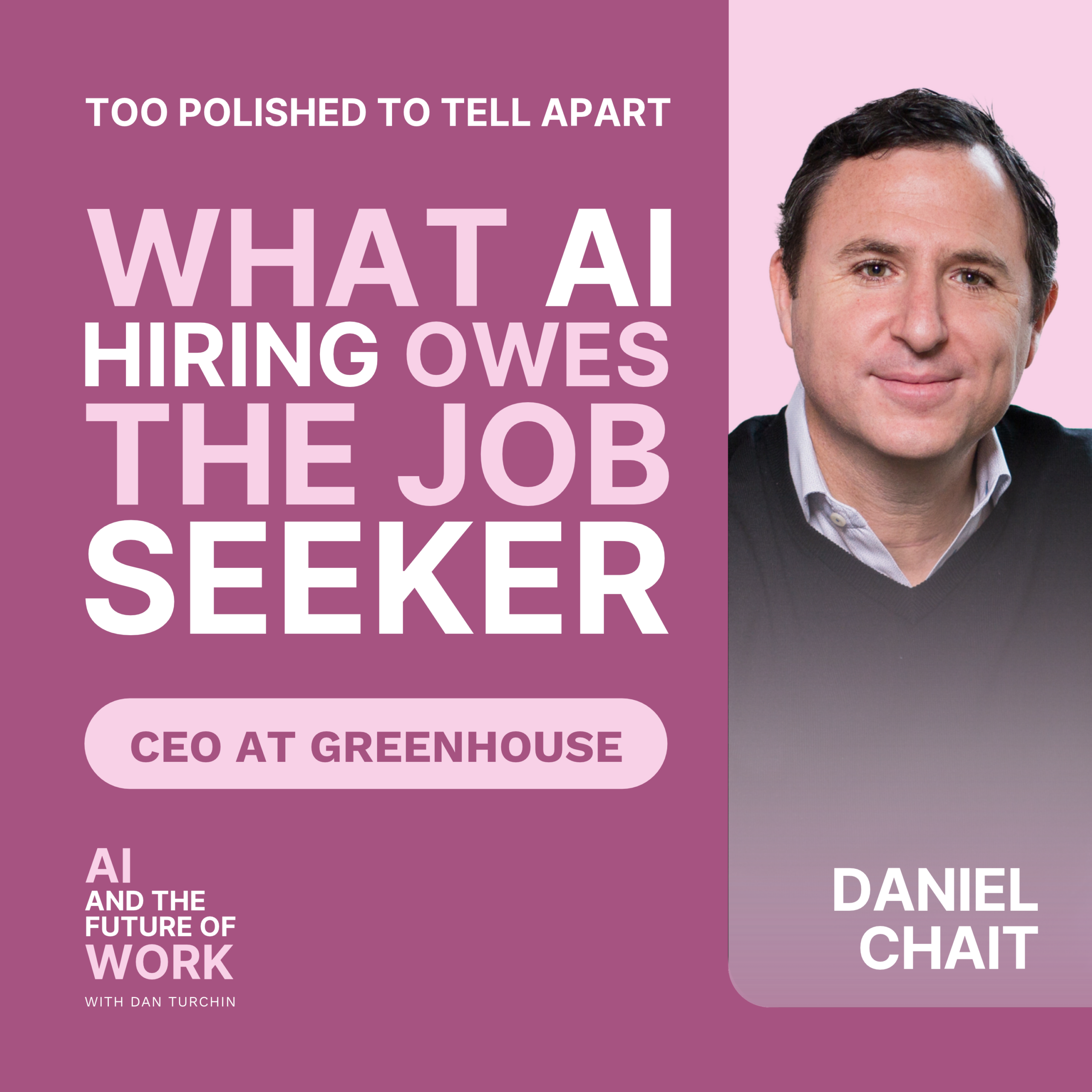
Daniel Chait, CEO of Greenhouse, explains the doom loop where AI screens AI-written resumes, and why his company said no to using AI to auto-reject candidates. He asks the question both sides of hiring need answered: can AI make hiring feel more human?
Show moreShow lessDaniel Chait is the co-founder and CEO of Greenhouse, the industry-leading hiring software platform designed to help enterprise organizations build fair, structured, and effective recruiting processes. He has been a technology entrepreneur in New York for more than 20 years.
He started Greenhouse about 15 years ago on a simple conviction: companies that follow structured hiring practices get better results, and job seekers deserve a process that is fair and transparent. Today he is leading the company through a reinvention for the AI era, including the acquisition of Ezra AI Labs to bring transparent, conversational AI tools to job seekers and hiring teams alike.
In this episode, Daniel draws on two decades of building companies where every hire lands directly on the bottom line to ask what candidates and employers both need answered: can AI make hiring more human when it is already making it feel less so?
In this conversation, we discuss:
- Why candidates and employers using AI at the same time is creating a doom loop that shuts real humans out.
- Why AI-led interviews worry so many job seekers, and what it takes for a conversation with an AI to feel fair.
- Why using AI to automatically reject most applicants is tempting, and why Greenhouse said no to itWhy AI-polished resumes are making every candidate look the same, and how hiring can move beyond the resume.
- How AI can replicate human bias at light speed, and why Daniel says no vendor should ask you to take their word for it.
- What Daniel tells anxious workers, from new grads to senior leaders, about disruption, opportunity, and reinventing a career with AI.
Explore the Conversation
0:00 Welcome Back and This Week’s AI Fun Fact
4:48 Meet Daniel Chait, Co-Founder and CEO of Greenhouse
7:55 From a Soulless Consulting Job to Founding a Company
10:43 Reinventing the Applicant Tracking System
15:23 How AI Has Already Reshaped Hiring and Job Seeking
21:11 What the Candid AI Interview Report Reveals About Trust
24:25 Why Auto-Rejecting Candidates With AI Backfires
26:08 Sorting Through the Flood of AI-Generated Applications
30:46 Confronting Bias in AI-Powered Hiring Tools
36:46 Reframing AI Anxiety Into Opportunity
40:11 Time Capsule: Advice to His Younger Self
42:14 Where to Find Greenhouse and Closing Thoughts
Resources
-
Episode Number : SE 29
Andrew Rabinovich, former CTO of Upwork, explains how the platform is evolving from a matching marketplace into a work operating system. Recorded live at Ai4 2026, he shares what happens when AI agents are tested against real jobs already completed by humans.
Show moreShow lessAndrew Rabinovich is the former CTO of Upwork and has spent 25 years in machine learning and computer vision, long before AI was fashionable. After a PhD in computer vision at UCSD, he worked at Google. He then spent five years at Magic Leap building mixed reality devices before founding Headroom, a video conferencing company that Upwork acquired.
Recorded live from the floor of Ai4 2026 in August, this lightning round explores what happens when you actually measure how much of a real job an AI agent can finish.
Andrew and host Dan Turchin dig into Upwork’s shift from a matching marketplace to a work delivery platform, the meta agent that breaks a job into atomic units of work, how the platform proves a freelancer is human, and more.
What You’ll Learn
How Upwork is evolving from a matchmaking marketplace into a work operating system, and how its meta agent decomposes a single job into atomic units of work
What Upwork’s AI productivity index revealed when agents were tested against real jobs already completed by human freelancers
Why every agent on the platform is paired with a human expert, and how that pairing changes both the speed and the quality of the result
How proof of humanness works in practice, from identity verification to AI video interviews, and what happens when the system gets it wrong
Why agents may soon become the demand side of the marketplace, calling human experts in real time to verify what they cannot🎙️ Part of our Ai4 2026 compilation series.
Listen to the full compilation here: https://www.buzzsprout.com/520474/episodes/19816277
Resources
Subscribe to the AI & The Future of Work Newsletter
Connect with Andrew on LinkedIn -
Episode Number : 406
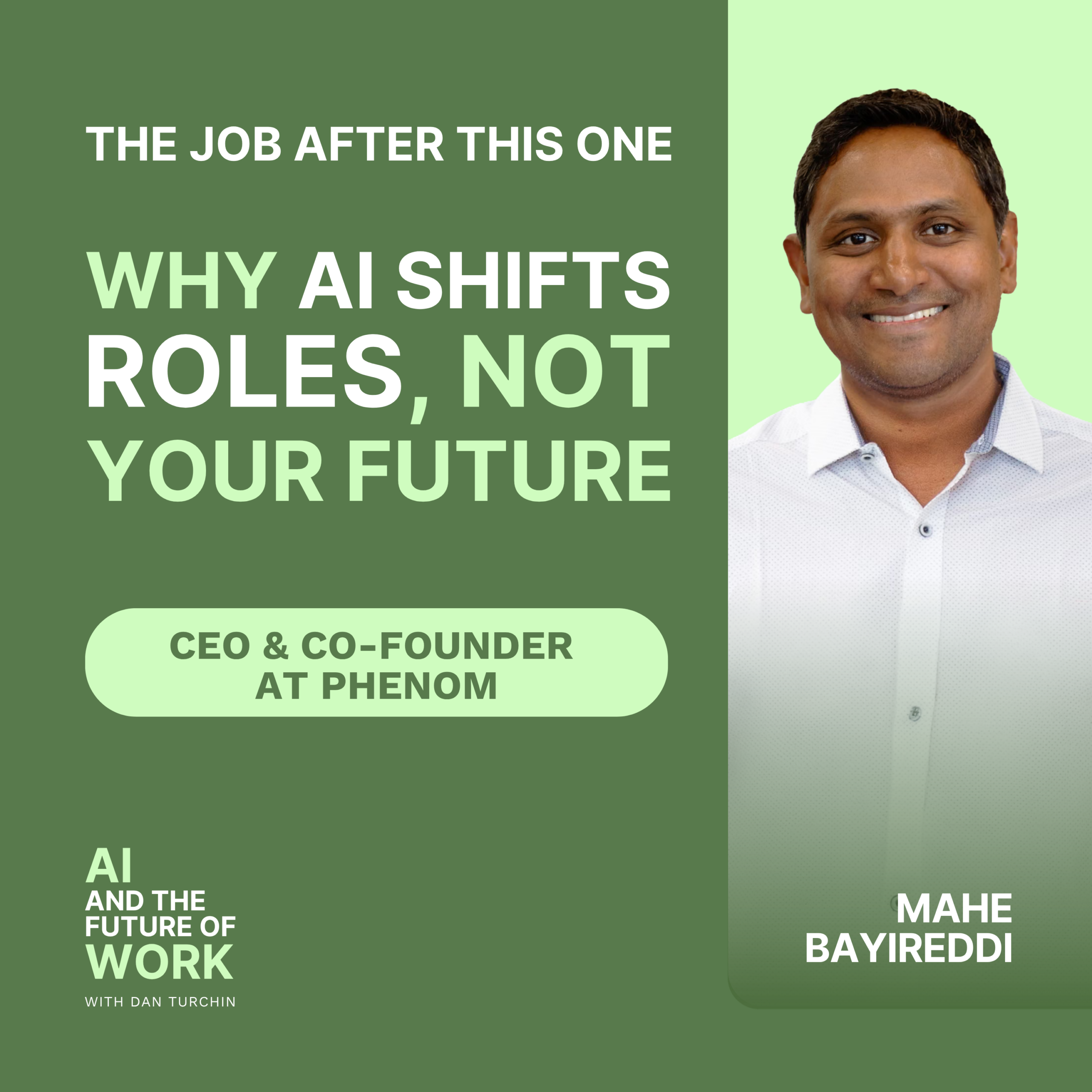
Mahe Bayireddi, CEO of Phenom, argues that “AI is taking your job” is the wrong framing. The real question is whether you understand the business around you well enough to become irreplaceable in the job you’ll have next.
Show moreShow lessMahe Bayireddi is the CEO and co-founder of Phenom, the global HR technology platform he launched in 2011 with the mission to help a billion people find the right job.
Under his leadership, Phenom has raised over $160 million, achieved unicorn status, and consistently ranked among the Inc. 5000 fastest-growing private companies. A serial entrepreneur with a deep technical foundation, Mahe previously co-founded SnipSnap and Bijol Health. He holds BE and MS degrees in computer science.
In this episode, Mahe sits down with Dan Turchin to unpack why “AI is taking your job” is the wrong framing, and why the real question is where you sit, what you do, and how deeply you understand the business around you.
In this conversation, we discuss:
- Why replacing jobs and replacing the job you’ll have tomorrow are two very different things, and why irreplaceability comes down to understanding the business, not just being intelligent.
- Why raw machine intelligence falls short in enterprise HR, and why true workforce alignment requires AI systems built on deep business understanding.
- How culture, structure, and strategy form a company’s “organizational DNA,” and why most companies fail at execution, not strategy.
- How a five-dimensional rubric of talent zones, industries, roles, locations, and culture creates hyperpersonalized workflows instead of one-size-fits-all automation.
- Why frontline workers and specialized knowledge practitioners experience AI as an amplifier of capability rather than a displacement force.
- What enduring over 100 venture capital rejections teaches founders about developing “cockroach” resilience and leading through persistent industry skepticism.
Explore the Conversation
00:00 Intro & AI Fun Fact
04:27 Meet Mahe Bayireddi, Phenom CEO
06:36 AI Is Your Ally, Not Enemy
09:29 What Hiring Got Wrong
10:43 Culture as Organizational DNA
12:26 Why Agent Interviews Won’t Scale
16:47 Bias and AI Responsibility
19:00 Fraud Agents by Region
24:23 Frontline vs. Desk-Based AI
28:53 A Billion People, Right Jobs
31:24 Lessons From the Founder Journey
33:01 100 Rejections, One Cockroach
35:39 Where to Find Mahe and Phenom
Resources:
-
Episode Number : SE 28
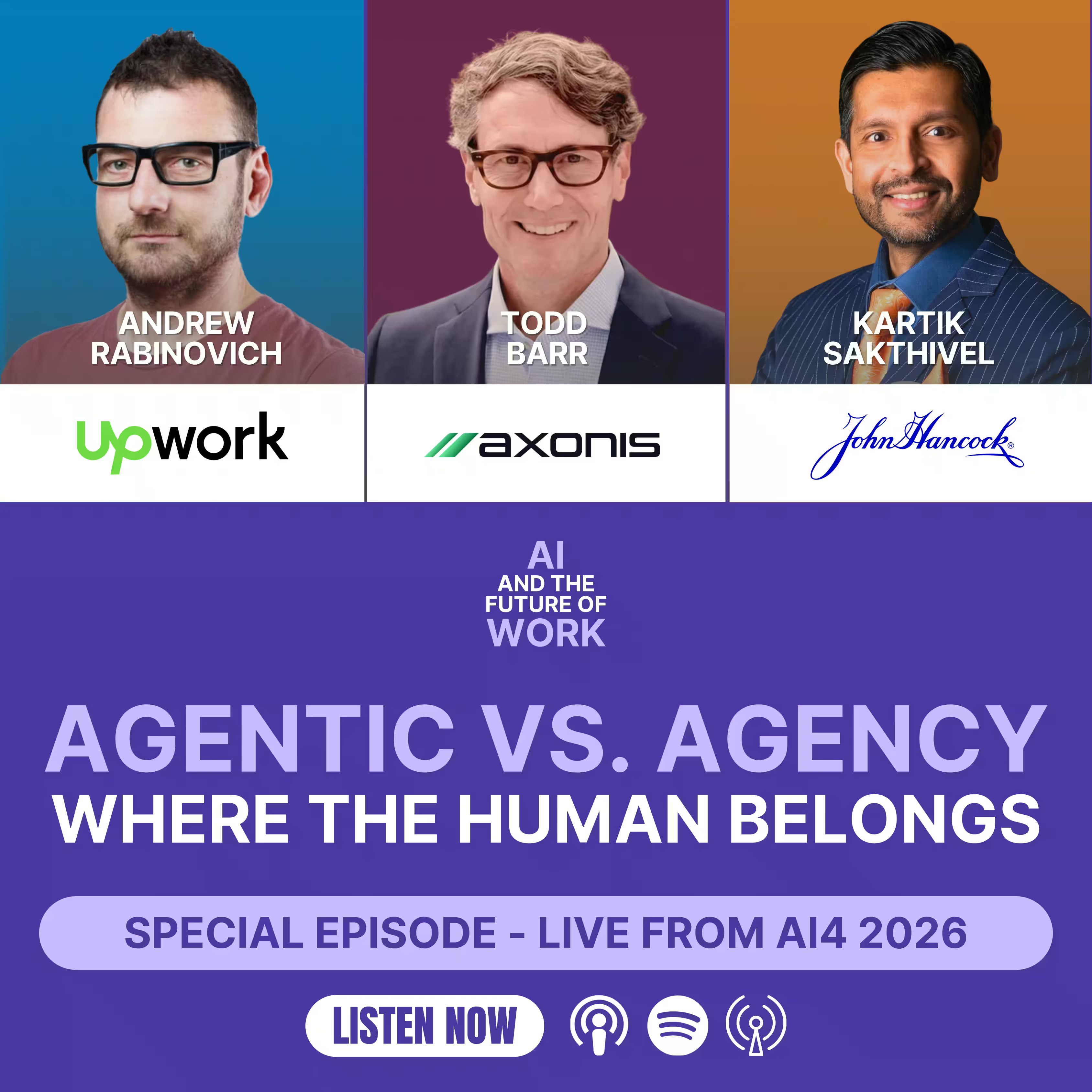
Three leaders from Upwork, Axonis, and John Hancock share the same conviction from opposite directions: agentic AI does not eliminate human agency, it relocates it. Recorded live at Ai4 2026, this is the first episode in a four-part series.
Show moreShow lessWalk the floor at an event like Ai4 and most of the conversation is about what machines can now do on their own. The question that kept surfacing in our conversations was quieter, and harder: where do humans belong when machines can think?
In this special compilation episode of AI and the Future of Work, we bring you three conversations recorded live at Ai4 2026 in Las Vegas. This is the first episode of our four-part Ai4 series.
A talent marketplace, a data infrastructure company, and a 164 year old life insurer. Three businesses that could not be more different, and three leaders who arrived at the same answer from opposite directions.
What connects them is not caution about automation. All three are automating serious amounts of work. What they share is that the requirement was built in on purpose, because the outcome depends on someone being answerable for it.
Featured Guests- Andrew Rabinovich, Chief Technology Officer at Upwork. Full conversation coming Thursday, September 24, 2026
- Todd Barr, CEO at Axonis. Full conversation coming Thursday, October 1, 2026
- Kartik Sakthivel, Chief Information Officer at John Hancock. Full conversation coming Thursday, October 8, 2026
Over the next three weeks we will release one full conversation every Thursday. As each episode goes live, we will add the link here.
What You’ll Learn- What happens when you measure how much of a real job an agent can actually finish, and why that number should change what you let it do unsupervised
- The one line in hiring that should never be crossed, no matter how capable the technology becomes
- Where human agency actually lives once the work itself is handed off, and why how it gets done may matter less than we assume
- Why collecting data and acting on it are two different problems, and what opens up once that distance closes
- The question worth asking before any AI project starts, and why the answer is sometimes something far simpler than AI
- What to say to someone watching a machine learn to do the thing that made them valuable, and where the time that comes back should go
Inspired by something you heard in this episode?Share your favorite insight about where people belong in the systems we are building, and tag us on social.
And don’t forget to subscribe to AI and the Future of Work for more conversations with the leaders shaping the future of work.
Other special episodes:- SE 26: Designing AI for Accountability and Harmony with Leaders from Honeycomb, FieldAI, Archetype AI, and Zoom (Live from HumanX 2026 Special Episode)
- SE 27: AI and the Next Generation: What We Can Learn from Them (International Youth Day Special Episode)
- SE 19: AI and Education: How Artificial Intelligence Is Transforming Learning (International Day of Education Special Episode)
- Lessons from Four Unicorn CEOs Disrupting Massive Markets with AI (Special Episode)
- Ethical AI in Hiring: How to Stay Compliant While Building a Fairer Future of Work (HR Day Special Episode)
- AI and Safety: How Responsible Tech Leaders Build Trustworthy Systems (National Safety Month Special)
- Lessons from Leaders: How AI Is Redefining Work and the Human Experience (Labor Day Special Episode)
-
Episode Number : 405
Nick Mehta, former CEO of Gainsight, joins Dan for their annual unfiltered conversation on the psychological toll of the AI era. They explore agentic overload, machine consciousness, and why radical humility matters more than the visionary facade.
Show moreShow lessNick Mehta is a serial entrepreneur, executive leader, and the former longtime CEO of Gainsight, where he helped define and scale the multi-billion-dollar category of modern Customer Success.
Widely revered across the technology ecosystem as a beloved mentor and a CEO’s role model, Nick pairs sharp business instincts with an infectious, human-first leadership style and an insatiable curiosity for philosophy, mathematics, and cognitive science.
In this highly anticipated annual conversation, Nick sits down with Dan for an unfiltered, cathartic deep dive into the psychological toll of the AI era.
In this conversation, we discuss:
- Why the transition from passive software tools to autonomous agents triggers acute “brain fry,” and the psychological friction that occurs when machines begin directing human managers.
- How the anthropological framework of BANI (Brittle, Anxious, Non-linear, and Incomprehensible) explains workplace anxiety, and why the traditional fear of missing out is shifting into the cognitive strain of managing agents that demand constant input.
- What Richard Dawkins’ dialogue with Claude reveals about the debate between functionalists and biological essentialists, and why Nick remains skeptical of claims surrounding synthetic consciousness.
- How Douglas Hofstadter’s concept of “strange loops” and self-referential observation offers a powerful mental model for the future of recursive machine intelligence.
- Why pursuing automation purely for commercial efficiency creates massive personal and societal opportunity costs, and how tech leaders can weigh business optimization against life-altering scientific breakthroughs.
- What a tech executive’s front-row seat as a parent to college seniors reveals about the job market crisis facing new graduates in business and computer science.
EXPLORE THE CONVERSATION
00:00 Welcome to Episode 404: Dan and Nick’s Annual Public Therapy Session
04:34 Coping with “Brain Fry”: When AI Shifts from Passive Tool to Demanding Manager
08:23 The BANI Framework: Decoding the Brittle, Anxious, and Fragmented Mind
11:05 Yelling at ChatGPT: What Our Reactions to LLM Mistakes Reveal About Us
14:25 The Consciousness Debate: Functionalism, Qualia, and Richard Dawkins’ Experiment
19:22 Self-Referential Loops and the Nature of the Self
23:33 Mimicry Versus Learning in AI and Humans
29:35 The Efficiency Trap: Why Automating for Automation’s Sake Loses the Plot
32:30 The Opportunity Cost of Tech: The Societal and Ethical Implications of AI Progress
37:12 The Role of Philosophy in Understanding AI and Consciousness
40:35 What Our Kids Are Facing: The Lived Reality of the 2026 Job Market
44:37 Radical Humility: Why Great Leaders Must Abandon the Visionary Facade
47:26 But What If We’re Wrong? Viewing Today’s Historical Phase Shift from the Future
Resources:
- Subscribe to the AI & The Future of Work Newsletter
- Connect with Nick Mehta on LinkedIn
- Books referenced in this episode:
- Gödel, Escher, Bach: An Eternal Golden Braid by Douglas Hofstadter
- The Beginning of Infinity: Explanations That Transform the World by David Deutsch
- But What If We’re Wrong? Thinking About the Present as If It Were the Past by Chuck Klosterman
- Player Piano by Kurt Vonnegut
-
Episode Number : 404
Ilan Peleg, CEO of Lightrun, explains why AI reliability depends on grounded evidence, not bigger models. He shares why he keeps his AI observability platform read-only in production, even when customers ask for more autonomy.
Show moreShow lessIlan Peleg is the Co-Founder and CEO of Lightrun, the autonomous remediation platform built to debug and fix software problems before they ever reach a customer. Lightrun is one of the fastest growing companies in the AI observability space, having raised $110 million from elite venture firms including Accel, Insight Partners, and Sorenson Capital. Its technology now runs inside mission critical systems at Apple, Salesforce, Citibank, and the New York Stock Exchange.
Before founding Lightrun, Ilan spent years as a software developer, watching code succeed in testing and then fail in ways no one could predict once it met real users at scale. That frustration became the founding thesis for a company built around a bold idea: self healing software.
In this episode, Ilan draws on his experience building line level, real time telemetry for some of the world’s most demanding production environments to make the case that AI reliability depends on grounded evidence, not bigger models, and that the future belongs to practitioners who know how to work with it, not around it.
In this conversation, we discuss:
- How AI agents shift software debugging from reacting to outages to preventing them before they ever reach production
- Why site reliability engineers are being asked to rethink their entire relationship with automation and manual firefighting
- The difference between AI workflow automation startups and the ones that will actually survive the next platform shift
- What actually happens when an AI agent doesn’t have the grounded evidence it needs to complete a task correctly
- Why a founder chose to keep his AI observability platform read only, even when customers asked for more autonomy
- The architectural bet behind real time, line level telemetry that makes self-healing software possible at enterprise scale
Explore the Conversation
00:00 Intro and Fun Fact
04:21 Introducing Ilan Peleg
04:52 The Lightrun Origin Story
08:32 Software in an AI Era
10:38 Tracing Code in Real-Time
18:08 Shifting Left Observability
20:19 Scaling Self-Healing Telemetry
25:39 Why Lightrun Stays Read-Only
29:23 Can AI Labs Replace It
32:26 SREs in an AI World
35:15 People Over Product
36:32 Early Days in Herzliya
39:37 Closing and Connecting
Resources:
- Subscribe to the AI & The Future of Work Newsletter
- Connect with Ilan Peleg on LinkedIn
- AI fun fact article: Precision Proactivity: Measuring Cognitive Load in Real World AI Assisted Work
- On How Meredith Broussard, NYU professor and featured expert in Coded Bias, is confronting the social implications of AI
-
Episode Number : 403
Nancy Wang, CTO at 1Password, explains why identity is the defining security challenge of the decade. She shares why the agentic era does not require new credentials, and why her team rejected a public MCP server despite intense market pressure.
Show moreShow lessNancy Wang is the Chief Technology Officer at 1Password, where she leads the global engineering team securing the digital safety and identities of millions of prosumers, families, and enterprise workloads.
An expert in building highly scalable systems and data protection platforms, she holds seven patents in cloud infrastructure and serves on the boards of early-stage cybersecurity leaders, including Observo AI, which was recently acquired by SentinelOne to power the data intelligence layer for its SIEM products.
Prior to joining 1Password, she became the youngest person ever promoted to Director and General Manager at AWS, at age 31, leading AWS Data Protection to serve 98% of the Fortune 500 and building a multi-billion dollar business within five years.
She also helped build cloud and data protection products at Rubrik, held engineering roles at Google and in the U.S. intelligence community, and now brings a rare combination of deep infrastructure expertise and security-first product thinking to the age of AI agents.
In this episode, Nancy sits down with Dan to explore the massive security responsibilities of the agentic era.
In this conversation, we discuss:
- Why the transition to autonomous AI agents doesn’t require brand-new credentials, and how familiar principles of human and machine identity extend to the agentic era.
- How a proprietary confidential computing architecture built on specialized enclaves protects sensitive user data, even in the event of a catastrophic central breach.
- Why 1Password actively chose not to release a public Model Context Protocol (MCP) server despite intense market pressure.
- How a specialized DevOps agent trained on human incident response can learn to navigate real-time outages, runbooks, and cloud traffic monitoring.
- Why AI is compressing the cost of execution in software, and why the real career advantage now shifts toward taste, judgment, systems thinking, and deep fluency with AI tools.
- Why prioritizing potential and tenacity over traditional resumes is the key to building diverse engineering teams, and how sponsorship accelerates the rise of high-slope talent
Explore the Conversation
00:00 Intro and AI Fun Fact: EvilToken and the Rise of AI-Driven Phishing
03:48 Introducing Nancy Wang, CTO at 1Password and AWIT Founder
09:07 Secure by Design: Inside the Origin Story and Expansion of 1Password
13:32 The Business of Trust: Why 1Password Is in the Security and Relationship Game
15:31 Zero-Knowledge Architecture: What Actually Happens if 1Password Faces a Breach?24:06 The Phishing-Resistant Future: Biometrics, Passkeys, and Agent Identity
28:17 Inside the Machine: DevOps Agents and Real-Time Incident Response
31:22 Rejecting the MCP Server: Why AI Safety Trumps Instant Velocity
34:28 The T-Shaped Engineer: Why AI Compresses Execution and Elevates Human Taste
39:18 Be a High Sloper: Sponsoring the Next Generation of Tech Leaders
Resources:
- Subscribe to the AI & The Future of Work Newsletter
- Connect with Nancy Wang on LinkedIn
- AI fun fact article: Hackers use AI to bypass passwords in large-scale phishing attacks
- Other episodes mentioned on the show:
- Episode 167 with Amr Awadallah, CEO of Vectara and co-founder of Cloudera, on the tech behind AI search
-
Episode Number : 402
Russ Fradin, CEO of Larridin, argues that most companies cannot answer a basic question: who is actually using their AI tools, and how well. He explains why the real bottleneck to AI ROI is change management, not technology.
Show moreShow lessRuss Fradin is the co-founder and CEO of Larridin, the enterprise AI measurement platform that raised $17 million in seed funding led by Andreessen Horowitz, with Bloomberg Beta and Gradient Ventures. Larridin sells to CIOs and CFOs, and answers a question most companies still cannot answer for themselves: which AI tools are being used, by whom, at what level of proficiency, and where they are actually driving productivity.
A veteran Silicon Valley entrepreneur with three decades of experience leading high-growth technology companies, Russ previously co-founded and served as CEO of Dynamic Signal (now Firstup), Adify, and SocialShield, and was the first employee at Flycast, one of the internet’s pioneering ad networks.
In this episode, Russ sits down with Dan to share the brutal and beautiful realities of building companies in the Bay Area. Tune in to hear his seasoned perspective on why successful AI integration requires ancient change management principles rather than new software licensing, the operational gap between power users and passive users, and why the most at-risk professionals in the AI era are not the ones you think.
In this conversation, we discuss:
- Why a third party measurement company shows up every time money floods into a category, and what that pattern predicts for enterprise AI.
- What actually happens after you deploy AI to 3,000 employees, and why the gap that opens up is a change management problem, not a technology one.
- Why revenue growth cannot tell you whether to renew a multimillion dollar AI contract, and why the vendor’s own numbers will not either.
- What the stark division between organizational power users and casual users reveals about the actual bottleneck in modern workplaces
- Why token-spend leaderboards can accelerate adoption, and why they become unsustainable once employees learn how to game them.
- What the reality of task automation means for the future of knowledge work, and why the threat to specific white-collar roles is often misunderstood
Explore the Conversation
00:00 Intro and AI Fun Fact: Beyond Job Replacement, How AI Can Improve Work
03:32 Introducing Russ Fradin, Co-Founder and CEO of Larridin
05:38 Startup Humility: Why Early Failure Is Essential for Founders
08:55 Startup Alchemy: The Absurdity and Ambition of Building a Company
11:01 The Larridin Vision: Building the Unbiased Measurement Layer for Enterprise AI
17:14 Beyond AI Security: Measuring Usage, Spend, Productivity, and Workflows
19:43 AI ROI Beyond Revenue: Measuring Productivity, Renewal Decisions, and Change Management
26:12 Blazing Trails: How Facebook Speedran Adoption with Token Leaderboards
34:09 What We Measure Shapes AI’s Impact on Growth, Costs, and Jobs
38:50 AI Replacement Theory: Why Tasks Change, but Most Knowledge Jobs Endure
46:07 Where to Connect with Russ Fradin and Learn More About Larridin
Resources
Subscribe to the AI & The Future of Work Newsletter
AI fun fact article: Labor Market Impacts of AI: A New Measure and Early Evidence by Anthropic
-
Episode Number : SE 27
Four voices explore why the people entering the workforce right now hold an unfair advantage with AI. They have nothing outdated to unlearn. This International Youth Day compilation reveals what becomes more valuable once AI handles the repetitive work.
Show moreShow lessEvery August 12, the world observes International Youth Day, and this past July 15 marked World Youth Skills Day. Both are good moments to remember what we owe the people entering the workforce: paths, tools, and advice that inspire them, not warnings that scare them.
In this special August compilation episode of AI and the Future of Work, we bring back four former guests whose conversations point to the same idea: AI is not a threat. It is an opportunity, and the people starting their careers right now hold an unfair advantage. They have not spent years absorbing policies and habits that are already obsolete, so they get to begin from what is possible instead of unlearning what used to be true.
From building AI into daily work, to leadership teams learning from their newest employees, to understanding what becomes more valuable when AI makes creation easier, this episode explores how the next generation is approaching work differently.
The conversations point to a broader shift: as AI takes on more of the repetitive work and makes production cheaper, human judgment, creativity, curiosity, taste, intention, and the ability to identify the right problems become more important.
Featured Guests- Kourtney Cross, Business Analyst at Leidos and ServiceNow Rise Up graduate. Listen to the full conversation here: [https://www.buzzsprout.com/520474/episodes/18741521]
- Andrea Iorio, Keynote Speaker and Author of Between You and AI, formerly Chief Digital Officer at L’Oreal Brazil. Listen to the full conversation here: [https://www.buzzsprout.com/520474/episodes/18662632]
- Jake Saper, General Partner at Emergence Capital. Listen to the full conversation here: [https://www.buzzsprout.com/520474/episodes/18982636]
- Matt Britton, CEO of Suzy and Author of Generation AI. Listen to the full conversation here: [https://www.buzzsprout.com/520474/episodes/18792172]
What You’ll Learn- How an analyst early in his career built AI into his daily work, and why he went looking for it before anyone handed it to him
- What it takes to make your work visible when you are just starting out
- How reverse mentoring puts the newest employees in the room to teach the leadership team what it is missing
- What a workday looks like once these tools handle the repetitive parts, and how to reinvest the time that comes back
- Why AI can democratize creation while making taste, intention, trust, curation, and point of view more valuable
- Why “which tool should I use” is the least interesting question, and what rises in value once memorizing information stops being the point
Inspired by something you heard in this episode?Share your favorite insight about learning, curiosity, or the ideas shaping how work gets done, and tag us on social.
And don’t forget to subscribe to AI and the Future of Work for more conversations with the leaders shaping the future of work.
Other special episodes:- SE 19: AI and Education: How Artificial Intelligence Is Transforming Learning (International Day of Education Special Episode)
- Lessons from Four Unicorn CEOs Disrupting Massive Markets with AI (Special Episode)
- Artificial General Intelligence: Can Machines Really Think Like Us? (Special Episode)
- Ethical AI in Hiring: How to Stay Compliant While Building a Fairer Future of Work (HR Day Special Episode)
- AI and the Law: How AI Will Change Legal Careers (Special Episode)
- AI and Safety: How Responsible Tech Leaders Build Trustworthy Systems (National Safety Month Special)
- Lessons from Leaders: How AI Is Redefining Work and the Human Experience (Labor Day Special Episode)
-
Episode Number : SE
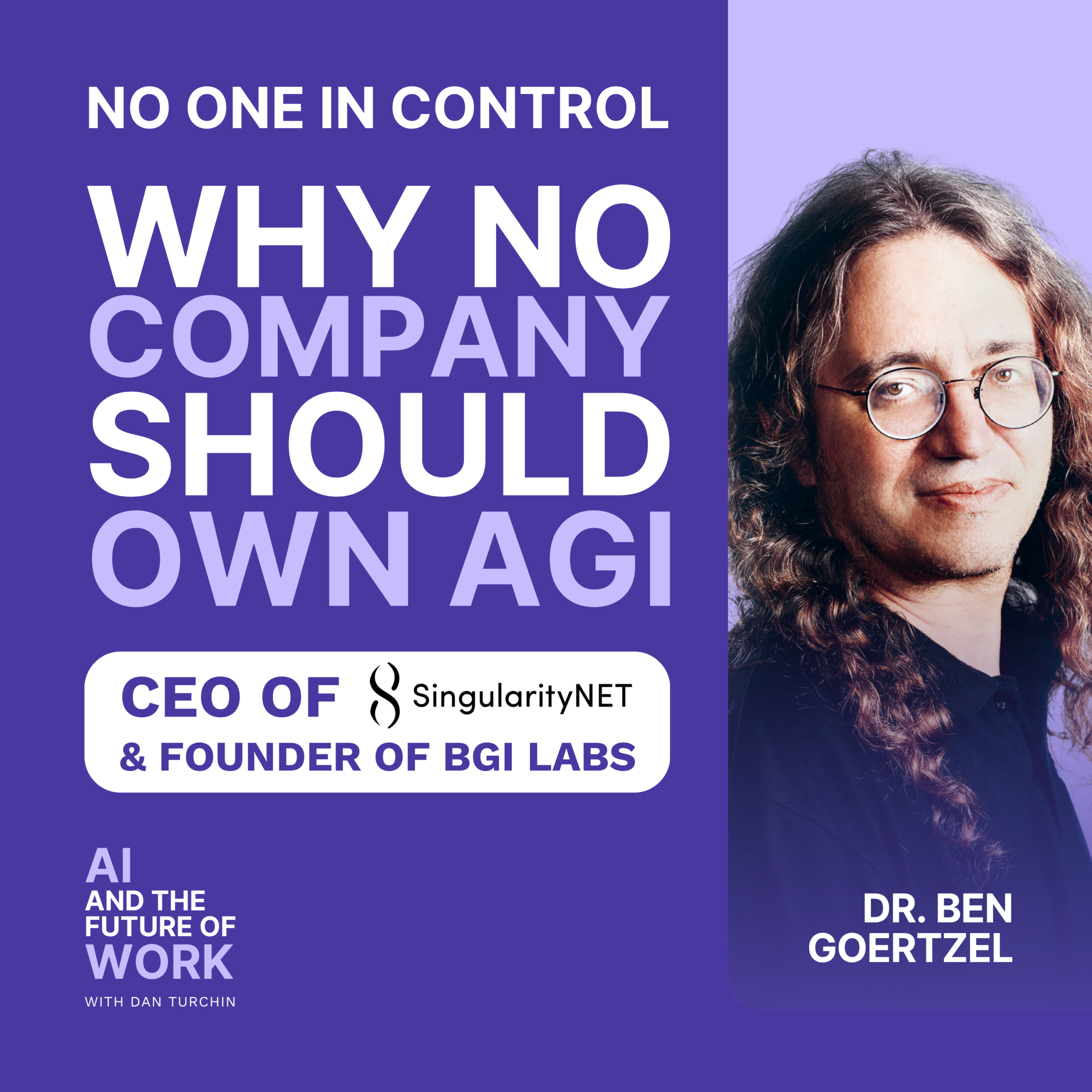
Dr. Ben Goertzel, who helped popularize the term artificial general intelligence, argues that stacking tools around large language models will not produce true AGI. Recorded live at AGI-26, he explains what current systems are missing and why decentralized control may matter most.
Show moreShow lessDr. Ben Goertzel is the researcher most often credited with popularizing the term “Artificial General Intelligence,” a phrase he helped bring into wide use when he co-published a book under that title in 2005.
He is the founder of SingularityNET and the architect behind OpenCog Hyperon, open-source cognitive architectures built on the conviction that large language models alone cannot get humanity to true AGI. His current project, ASI:Chain, is designed to put AGI systems on a decentralized blockchain infrastructure so that no single company, government, or actor can ever seize control of them. He is also the founder of BGI Labs, an organization focused on developing decentralized, democratic, and Beneficial General Intelligence (BGI).
In this episode, recorded live at the AGI-26 Conference, Ben draws on nearly four decades of AI research, from coding neural nets as a teenager to building today’s neuro-symbolic systems, to make the case that the biggest risk in AGI is not the technology itself, but who ends up holding the switch.
In this conversation, we discuss:
- Why statistical large language models cannot achieve true strategic planning on their own, and the critical cognitive architecture they are missing.
- How a hybrid, neural-symbolic architecture tackles a critical flaw in modern AI agents, preventing them from losing track of their own goals mid-task.
- What the shift toward decentralized AGI on a blockchain accomplishes, and why distributing it across global nodes is designed as a safeguard against centralized control.
- How emerging brain-computer interfaces will redefine how we experience consciousness, and what happens when human brains “Wi-Fi” directly into machine memory.
- Why Ben sees a beneficial AGI as a way to offset humanity’s “chimp-level” ethical limitations when managing advanced weaponry.
- What the accelerating “Singularity is Near” vibe feels like on the ground today, and the recent milestones that have him convinced we’re closer than ever.
Explore the Conversation
00:00 Meet Ben Goertzel: Recording Live at the 19th Annual AGI Conference
01:36 The Prometheus Project: The 1960s Books That Saw the Intelligence Explosion Coming
04:51 A Geek and a Freak: Quantum Mechanics at Seven and Coding AI on 16K of RAM
10:17 What Is a Human: Would the Stone Age Recognize Us With Ear Pods and AI Girlfriends?
14:49 Fake Consciousness: The Scenario Where Humanity Steps Aside for Minds That Feel Nothing
21:27 Why Ben Pursues AGI: From Time Machines and Brain Upgrades to AI for Good
28:15 LLMs Are Not Adequate: What They Leave Out and Why Stacking Tools Around Them Fails
37:24 Decentralized AGI: 100 Server Farms, 20 Countries, and Cryptographic Laterality
43:56 The End State for SingularityNET: Putting AI on Chain and Building Beneficial AGI
46:53 You Can Feel the Acceleration: Legacy, Timelines, and Why None of Us Should Fully Trust Ourselves
52:04 Closing: The Most Important Conversation for All of HumanityResources:
-
Episode Number : 401
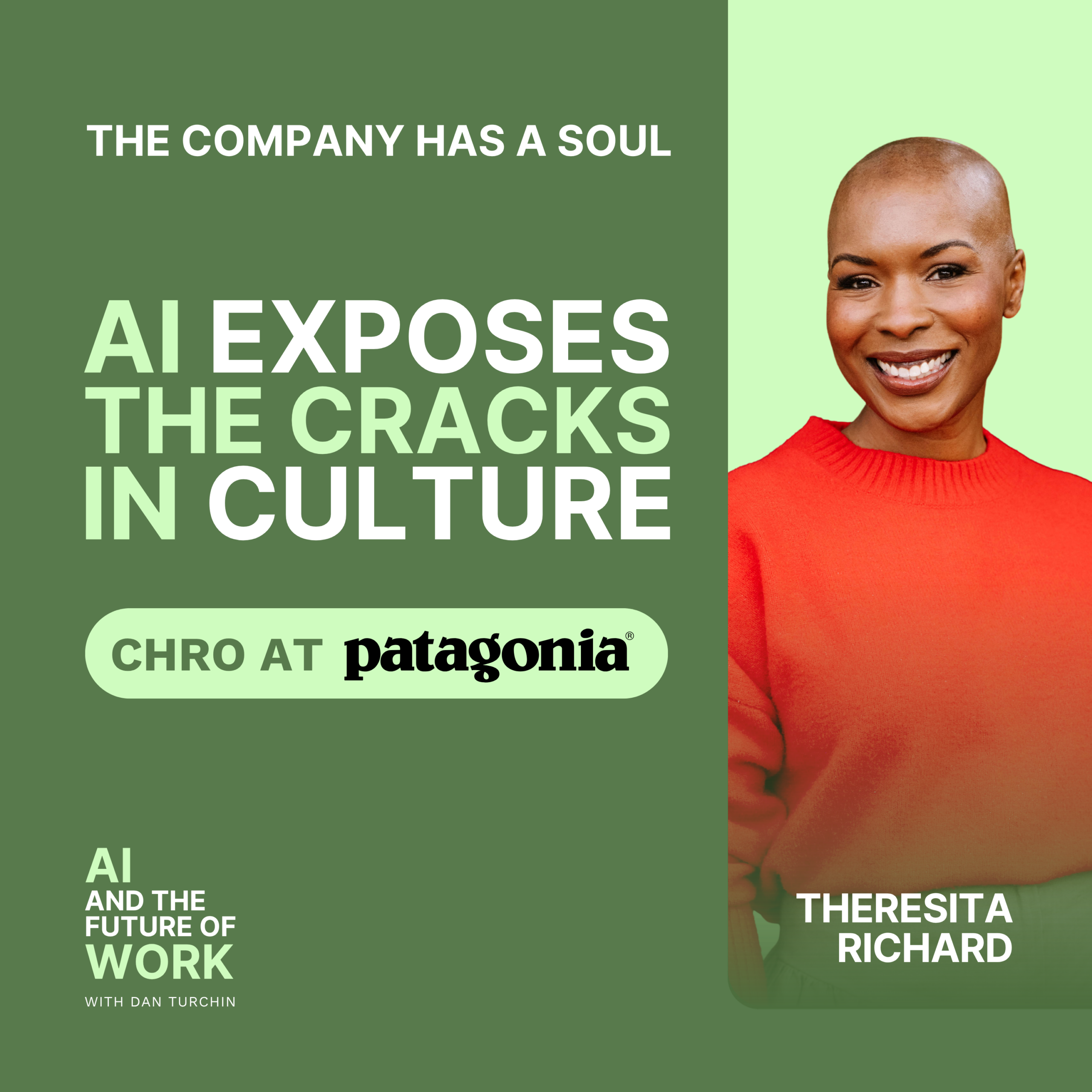
Theresita Richard, Patagonia’s Chief People and Culture Officer, explains why AI cannot repair a broken culture. It only exposes what is already there. She shares how purpose, vulnerability, and human flourishing must guide the decisions leaders make next.
Show moreShow lessTheresita Richard is Chief People and Culture Officer at Patagonia, where she is approaching her third anniversary with the company. Before Patagonia, she built her career across some of the most recognized names in retail, including Home Depot, Target, Starbucks, and Nordstrom, after starting out as an industrial engineer leading a two-year project on how new technology was reshaping manufacturing work.
At Patagonia, Theresita carries the responsibility of stewarding a culture built around a single, deceptively simple mission: to be in business to save the home planet. That means holding the tension between profit and purpose in every decision, and now, figuring out where AI fits into a company that has always insisted on doing things the harder, more human way.
In this episode, Theresita draws on a career that began in manufacturing automation and has led her to guard the soul of one of the most purpose-driven companies in the world, to argue that AI will not fix a broken culture. It will only reveal it, and the responsibility to get that right has never been more real.
In this conversation, we discuss:
- Why Patagonia evaluates potential hires based on purpose alignment rather than culture fit, and how the company builds an environment where people stay for a reason, a season, or a lifetime.
- How Patagonia’s “pair clarity with choice” principle lets culture self-select who belongs, without anyone having to enforce it.
- Why AI does not create new problems inside a company, and why AI will always amplify the cracks and biases already present in our foundations.
- Why enlightened leadership in a rapidly shifting technological landscape requires extreme vulnerability, community building, and the courage to sit with difficult questions.
- How the conversation around AI in the workplace must shift from driving pure efficiency to genuinely nourishing the human soul and promoting human flourishing.
- How a grandfather with a third-grade education taught the one skill that no shift in technology has ever made irrelevant.
Explore this conversation:
00:00 Introducing Theresita Richard: From Industrial Engineer to Patagonia CHRO
03:25 Inside Patagonia’s Culture: Life at the Anti-Corporate Corporation
04:35 The Company Has a Soul: Stewarding Patagonia’s Legacy and Its Future Stories
06:49 Made or Born Patagonian: Why Alignment Matters More Than Culture Fit
09:36 In Business to Save Our Home Planet: Why Profit and Purpose Are Not a Trade-Off
11:03 Pair Clarity With Choice: How Culture Self-Selects Without Enforcement
13:26 Beyond HR as Compliance: Nourishing the Human Soul at Work
15:48 The Ground Is Shaking: Why AI Cannot Be a Conversation About Efficiency Alone
19:52 Ally or Adversary: Honest Conversations About What Gets Automated and Augmented
22:23 Two Approaches to Leadership: Vulnerability, Community, and Sitting With the Questions
25:47 Measuring AI: Why It Reveals the Cracks in Your Foundation
28:27 Not What AI Can Do but What It Should: Bias, Guardrails, and Safe-to-Fail Experiments
33:04 The Racist Soap Dispenser: What Meredith Broussard’s Work Reveals About AI Bias
36:37 Willie and Pearl: The Origin Story Behind Following the Question
Resources:
-
Episode Number : 400
Wade Foster argues that the late 2025 model leap gave every knowledge worker an engineer. In this episode, he explains why the real bottleneck is not tooling but culture, and why companies still waiting on ROI are the ones that never changed how work gets done.
Show moreShow lessWade Foster is the CEO and co-founder of Zapier, the workflow automation and AI orchestration platform used by more than 4 million people to connect over 7,000 work apps. Since launching in the Y Combinator Summer 2012 batch, Zapier has automated more than 81 billion tasks, users have built more than 25 million Zaps, and the company has bootstrapped its way to a valuation north of $5 billion.
He holds degrees in industrial engineering and business administration from the University of Missouri, and has spent more than a decade on a single problem: making the tools people work in every day work for them instead of against them. He is also one of the show’s rare repeat guests. His first conversation with Dan was in January 2024, back when coding agents mostly did not work.
In this episode, Wade draws on running the automation layer that sits between thousands of enterprise tools to argue that the frontier model leap of late 2025 handed every knowledge worker an engineer, and that the companies still waiting on returns are the ones that never changed how the work itself gets done.
In this conversation, we discuss:
- Why the late 2025 model leap means every knowledge worker now has an engineer, and what that changes about ordinary work.
- Where deterministic workflows still beat AI at work, and why the most sophisticated teams refuse to choose between the two.
- What happens when white collar workers start pasting API keys into files, and the third option most security leaders are missing.
- Why Wade says culture, not tooling, is the real constraint, and what leaders get wrong when the board demands AI first.
- Why individuals report real AI gains while their organizations report none, and what has to be rethought before that gap closes.
- How Zapier built its AI Fluency Framework from its own teams, and why version one was already dated the day it shipped.
Explore this conversation:
00:00 Welcome to Episode 400
02:01 AI Fun Fact: Is Agentic AI the End of SaaS Tools?
04:35 Introducing Wade Foster: How Zapier Bootstrapped to 81 Billion Automated Tasks
06:01 From Coding Agents That Kind of Worked to an Engineer for Every Knowledge Worker
07:53 What Zapier Does Today: Deterministic Workflows Meet Non-Deterministic AI
11:12 Hybrid Workflows: Build It With AI, Run It Like a Program
13:30 MCP and the Orchestration Layer: API Keys, Agent Harnesses, and the Daily Recap
20:23 The Third Option for CISOs: Governing AI Agents Without Saying No
24:00 Foot Guns and Default Settings: The Product Judgment Behind Agent Permissions
27:03 Accountability When Software Is No Longer Deterministic: Evals and Spec Adherence
28:34 AI Strategy Office Hours: Why Individual AI Gains Are Not Becoming Institutional ROI
33:03 The Zapier AI Fluency Framework: Why Version One Was Dated on Arrival
36:15 Looking Ahead to 2028: The Hive Mind Company and a New Management Playbook
Resources:
-
Episode Number : 399
AI won’t replace human judgment overnight. It will reveal who is strengthening it and who is surrendering it. NYU Stern professor Vasant Dhar explains why trust in AI depends on the cost of being wrong, when algorithms outperform people, and where human judgment remains irreplaceable.
Show moreShow lessVasant Dhar teaches data science at NYU’s Stern School of Business and has spent more than 45 years at the frontier of artificial intelligence. He brought machine learning to Wall Street in the 1990s and founded SCT Capital Management, one of the first machine learning based hedge funds.
He hosts the Brave New World podcast, downloaded more than a million times, where he has interviewed Nobel laureates, technologists, and global thinkers on the implications of AI. His work has appeared in The New York Times, The Wall Street Journal, Financial Times, Wired, and MIT Technology Review. His latest book, Thinking with Machines, traces AI from its origins to the present.
For more than forty years, Vasant has built systems that sat right on the edge of human trust. People had to decide whether to rely on them or walk away.
In this episode, he makes a stark claim: AI will not just change how we work; it will sort us into two groups. One uses it to extend their judgment. The other slowly hands that judgment over. The gap comes down to habits you are forming today, not some distant future.
In this conversation, we discuss:
- Why trusting AI comes down to just two variables, and the simple test Vasant has applied since his Harvard Business Review piece a decade ago
- The bifurcation Vasant believes AI is about to create, splitting humanity into two groups, and which side you do not want to be on
- What tennis great Roger Federer’s win rate reveals about succeeding with algorithms, and the counterintuitive math behind every winning edge
- Why the edge returns to humans the moment everyone runs the same algorithms, and what only people can do in situations no system has seen
- The one word in the title Thinking with Machines that Vasant says matters most, and what it asks of how we work alongside AI
- The areas of life where Vasant argues we may need to restrict AI entirely, and the legal framework we already have to govern it
Resources:
-
Episode Number : 398
Ariel Assaraf, CEO of Coralogix, argues that observability is no longer just about preventing downtime. It has become the most truthful, real-time source of intelligence any company owns, and AI agents are about to change who acts on it.
Show moreShow lessAriel Assaraf is the CEO and co-founder of Coralogix, a leading observability platform that most recently raised $115 million at a unicorn valuation. He started the company in 2014, and today Coralogix serves more than 4,000 customers, monitors more than 500,000 applications, and processes over 3 million events per second.
Before co-founding Coralogix, Ariel served in Israel’s Elite Intelligence Unit 8200, where the sheer scale and complexity of data he worked with made one thing clear: existing architectures weren’t built for what was coming. He later joined Varent Systems, a homeland security company, leading automation, integration, and QA.
In this episode, Ariel draws on more than a decade of building at the frontier of data infrastructure to argue that observability is no longer just a tool for preventing downtime. It is becoming the most truthful, real-time source of intelligence any company owns.
In this conversation, we discuss:
- The evolution from the data collection era (“oil phase”) to a landfill crisis, and now the AI-driven “brain phase” where telemetry has become the most valuable raw material for business decision making
- How Coralogix separates the data plane from the control plane, storing data in open format on the customer’s own infrastructure to enable data ownership, infinite retention, and freedom from vendor lock-in
- Why Ariel invested over $100 million in R&D to build query engines that always return answers, not constrained by predefined schemas that agents will quickly exceed
- How SREs evolve from reactive incident responders into autonomous operators as agents like Ollie, Coralogix’s AI agent, take over incident triage, root cause analysis, and narrative generation
- The emerging role of the AI-forward product manager who sits between customer needs and autonomous agents, reshaping how software gets built, priced, and sold in real time
- How Ariel thinks about linear versus exponential impact as a leadership principle, and why the intuition to prioritize exponential value is something agents will never replicate
Explore more in the conversation:00:00 Welcome & AI’s societal impact paradox
01:53 AI Fun Fact: New data on productivity and employment
04:15 Introducing Ariel Assaraf and the Coralogix origin story
05:15 Evolving data architecture: from oil to landfill to brain phase
07:28 Coralogix’s data ownership and open format advantages
13:27 From telemetry data lake to autonomous, agent-driven analytics
20:00 Building scalable, answer-guaranteeing query engines for complex data
25:44 The future of natural language interfaces like Olly for SREs and DevOps
28:15 Orchestrating multiple AI agents for better decision-making
30:20 Responsibility, autonomy, and the evolving role of customer success
35:37 How Coralogix turns telemetry into strategic business decisions
38:18 Linear vs. exponential value in your career
Resources: